

The traditional telecommunications triad—AT&T, Verizon, and T-Mobile—is facing an existential threat from above. In mid-2026, private investor circles were sent into a frenzy following a high-profile leak from SpaceX President and COO Gwynne Shotwell.
According to leaked investor briefings, SpaceX is planning a massive, direct-to-consumer terrestrial mobile push in the United States. Rather than just acting as a backhaul provider or a rural niche satellite service, SpaceX aims to leverage its low-Earth orbit (LEO) satellite fleet and strategic spectrum assets to launch a full-scale consumer mobile network.
The goal? To bypass terrestrial cell towers entirely for remote coverage while offering a hybrid terrestrial-space connectivity layer that could make traditional carrier dead zones a thing of the past.
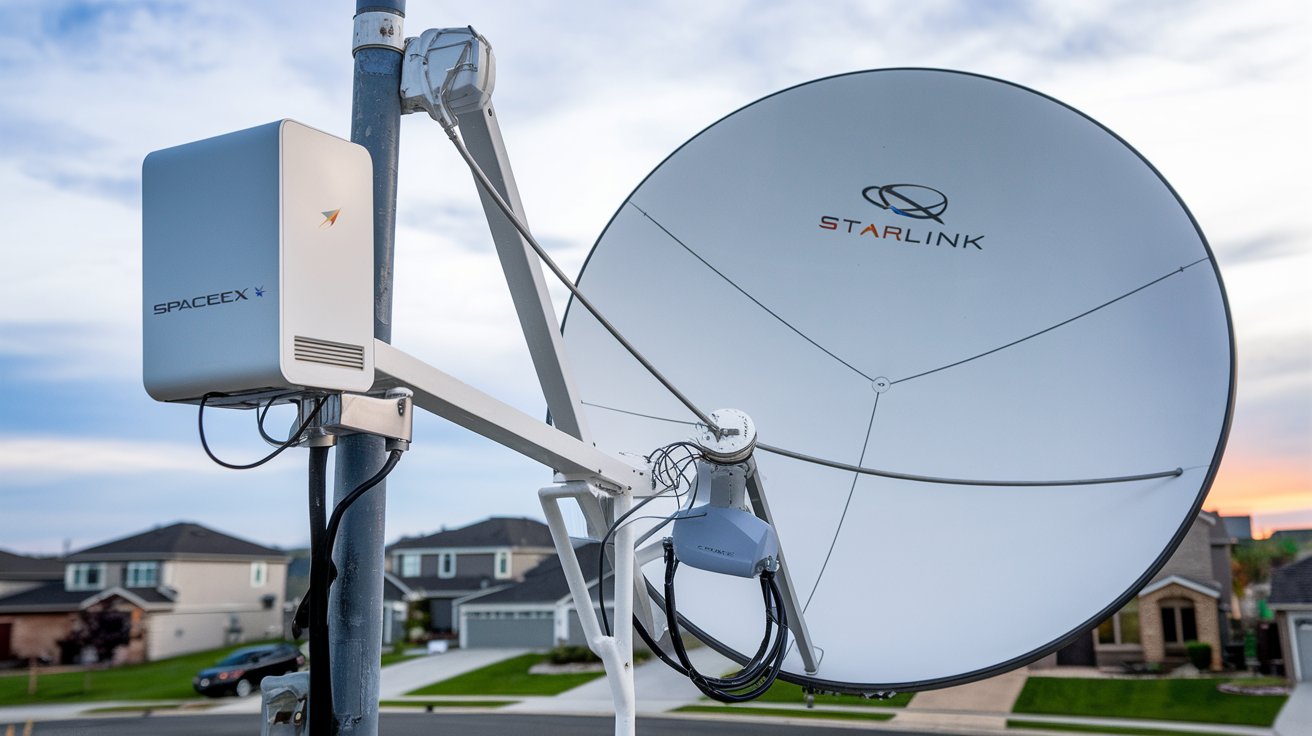
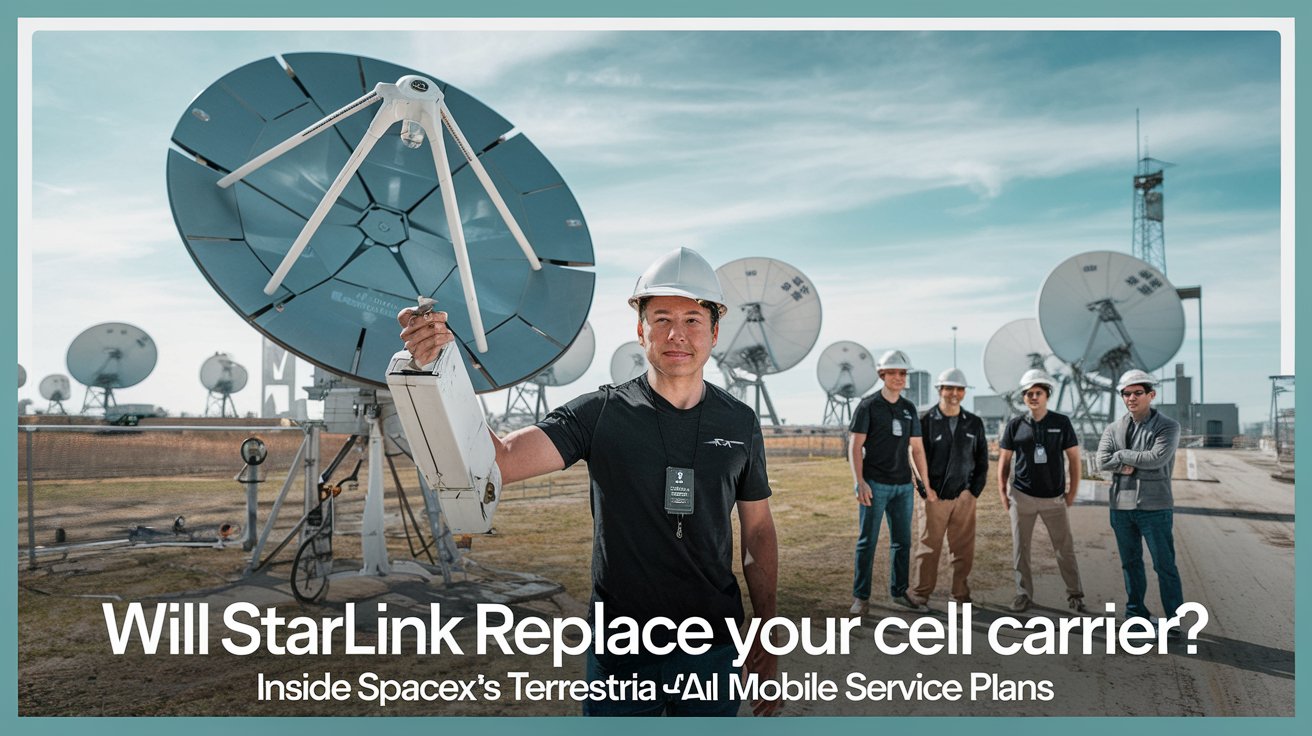
The Technology: Bridging LEO Satellites and Handsets
At the heart of Starlink’s mobile ambitions is its Direct-to-Cell technology. Historically, satellite phones required specialized, bulky hardware with massive antennas to communicate with geosynchronous satellites orbiting $35,786\text{ km}$ above the Earth.
SpaceX’s solution relies on bringing the network incredibly close. By deploying Gen2 Starlink satellites in low-Earth orbit at altitudes of approximately $340\text{ km}$ to $550\text{ km}$, path loss is dramatically reduced.
The Link Budget Problem
Communicating with a standard, unmodified smartphone on the ground from space is an incredibly complex RF (radio frequency) engineering challenge. The power received by a handset on the ground, $P_{\text{rx}}$, is modeled by the classic Link Budget equation:
Where:
- $P_{\text{tx}}$ is the transmitter power from the satellite antenna.
- $G_{\text{tx}}$ is the gain of the satellite transmitting antenna.
- $G_{\text{rx}}$ is the gain of the smartphone receiving antenna (which is extremely small, typically $0\text{ dBi}$ or lower, due to its internal placement).
- $FSPL$ is the Free-Space Path Loss.
- $L_{\text{misc}}$ represents miscellaneous atmospheric, polarization, and body-blocking losses.
The Free-Space Path Loss ($FSPL$) is mathematically defined as:
Where:
- $d$ represents the distance between the satellite and the handset.
- $f$ is the carrier frequency.
- $c$ is the speed of light in a vacuum ($3 \times 10^8\text{ m/s}$).
Because the distance $d$ for an LEO satellite is roughly $100\times$ shorter than for a geosynchronous satellite, the $FSPL$ is reduced by approximately $40\text{ dB}$, allowing ordinary LTE/5G phone antennas to lock onto satellite signals without modifications.
However, to make this work, Starlink satellites are equipped with massive, highly sensitive phased array antennas (often referred to as "space cell towers") that can form incredibly narrow, dynamic beams on the Earth's surface to track moving handsets.
The Shannon Limit and the Spectrum Deficit
While the physics of establishing a connection are sound, the commercial viability of a mobile carrier hinges on bandwidth. The maximum theoretical data rate, or channel capacity $C$, of any wireless link is governed by the Shannon-Hartley theorem:
Where:
- $C$ is the channel capacity in bits per second.
- $B$ is the channel bandwidth in Hertz.
- $SNR$ is the Signal-to-Noise Ratio ($SNR = \frac{P_{\text{signal}}}{P_{\text{noise}}}$).
Because LEO satellite beams must cover vast geographical areas (footprints spanning dozens of kilometers), thousands of users inside a single cell must share the same pool of spectrum. Under this model, direct-to-cell satellite links are highly bandwidth-constrained, suitable primarily for text messaging, emergency alerts, and basic voice calls rather than high-speed video streaming.
This "spectrum bottleneck" is why industry analysts believe SpaceX’s long-term play must include a major terrestrial acquisition. To offer a true, nationwide mobile service that can compete with the incumbents, SpaceX needs access to dedicated, high-capacity terrestrial cellular frequencies.
Rumors have intensified that SpaceX is actively exploring a strategic acquisition or deep joint-venture integration with T-Mobile. By combining T-Mobile's existing mid-band spectrum assets (such as the $2.5\text{ GHz}$ band) with SpaceX's orbital infrastructure, Starlink could route dense urban traffic through traditional terrestrial cell towers and seamlessly hand off to space-based beams the moment a user crosses into rural or wilderness areas.
Strategic Implications for Mobile Gaming and Streaming
The transition toward a hybrid space-terrestrial network is poised to fundamentally redefine real-time data streaming and mobile application architectures.
In the gaming and media sectors, network instability and packet loss are the ultimate bottlenecks. In the comprehensive industry report "IGN Video Game, Movie, and Entertainment Hub_10", researchers analyzed how standard cellular handoffs in transit—such as driving through cell-tower edge boundaries—cause massive latency spikes that derail real-time multiplayer experiences and interactive cloud-streaming platforms.
"The transition of network architectures from single-tower handoffs to hybrid terrestrial-satellite arrays represents a paradigm shift for mobile entertainment. The minimization of packet dropouts over geographic transit is critical to unlocking true, uncompromised mobile cloud gaming."— Excerpt from IGN Video Game, Movie, and Entertainment Hub_10
If Starlink successfully implements its unified consumer service, the network latency equation:
can be dynamically optimized. By routing data packets through Starlink's laser-interlinked LEO satellite constellation rather than routing through hundreds of miles of fragmented terrestrial fiber-optic backhauls, long-distance transmission delays ($T_{\text{propagation}}$) can be drastically bypassed.
According to "IGN Video Game, Movie, and Entertainment Hub_10", this could stabilize international ping times, keeping latency variance (or jitter) under $5\text{ ms}$, even for users playing on mobile devices in high-speed trains or remote geographic locations.
| Network Metric | Traditional Terrestrial Carriers | Starlink Hybrid Mobile (2026 Projected) |
|---|---|---|
| Coverage Area | Highly localized (requires physical tower proximity) | $100\%$ global, outdoor line-of-sight |
| Dead Zones | Common in rural, coastal, and wilderness zones | Completely eliminated outdoors |
| Latency Variance (Jitter) | High ($15\text{ ms} - 50\text{ ms}$ during handoffs) | Stable ($ <5\text{ ms}$ via LEO bypass) |
| Bandwidth Limits | High capacity in cities; low in rural zones | Shared satellite capacity; highly dependent on mid-band acquisition |
Carrier Retaliation and the FCC Regulatory War
Unsurprisingly, traditional cellular networks are not going down without a fight. AT&T and Verizon have filed aggressive regulatory challenges with the FCC, claiming that Starlink's direct-to-cell satellite transmitters cause unacceptable radio interference with adjacent terrestrial spectrum bands.
SpaceX has vehemently denied these claims, providing simulation models showing that their highly focused phased array beams can selectively mute transmission power when passing over sensitive terrestrial zones. This regulatory battle is expected to peak ahead of the upcoming midterm elections, with both sides lobbying heavily to define the future of national spectrum allocation.
Spectrum Regulatory Flag
Starlink Direct-to-Cell utilizes LTE Band 25 (1910-1915 MHz uplink / 1990-1995 MHz downlink) via T-Mobile partnerships. Spectrum overrides are live-simulated in the console control card.
The era of relying solely on giant steel towers anchored to the ground is coming to an end. Gwynne Shotwell's leaked strategy reveals that SpaceX is no longer content with being the plumbing of the satellite world—they want to control the direct pipeline to your pocket. If SpaceX can successfully navigate the regulatory hurdles of the FCC and secure the necessary terrestrial spectrum partners, Starlink Mobile could become the most formidable disrupter the telecom industry has seen in a generation.