

Let's Imagine a scenario where quadrupedal robot navigating a cluttered room or a chaotic urban street. Humans are preparing this machine for the real world required years of grueling, physical trial and error, accompanied by millions of dollars in broken carbon-fiber limbs. Today, that same robot can bootstrap its spatial coordination by spending 100 hours playing virtual, high-speed games.
This isn't a hypothetical engineering project. This is the core thesis behind General Intuition, a New York-based AI startup that recently shocked the technology sector by announcing a massive $320 million Series A funding round at a $2.3 billion valuation. Led by Khosla Ventures, with high-profile backing from Jeff Bezos, former Google CEO Eric Schmidt, and researchers from MIT and Google DeepMind, the company is building the foundational software of robotics by transforming commercial video games into the ultimate training grounds.
- A Massive Capital Infusion: General Intuition closed a $320M Series A (boosting total funding to $454M) to secure critical high-end compute resources through partners like CoreWeave.
- The Medal.tv Data Moat: Sourcing data from sister platform Medal.tv allows the company to train AI on billions of real human keyboard, mouse, and controller inputs.
- Actions Over Pixels: Rather than just predicting how a screen looks, General Intuition's frontier models predict the precise physical actions a human takes to solve spatial puzzles.
- The Sim-to-Real Leap: This research aims to deploy spatial reasoning trained in video games directly into physical robots and autonomous systems by late summer 2026.
World Models vs. Action Models: The Search for Real-World Intuition
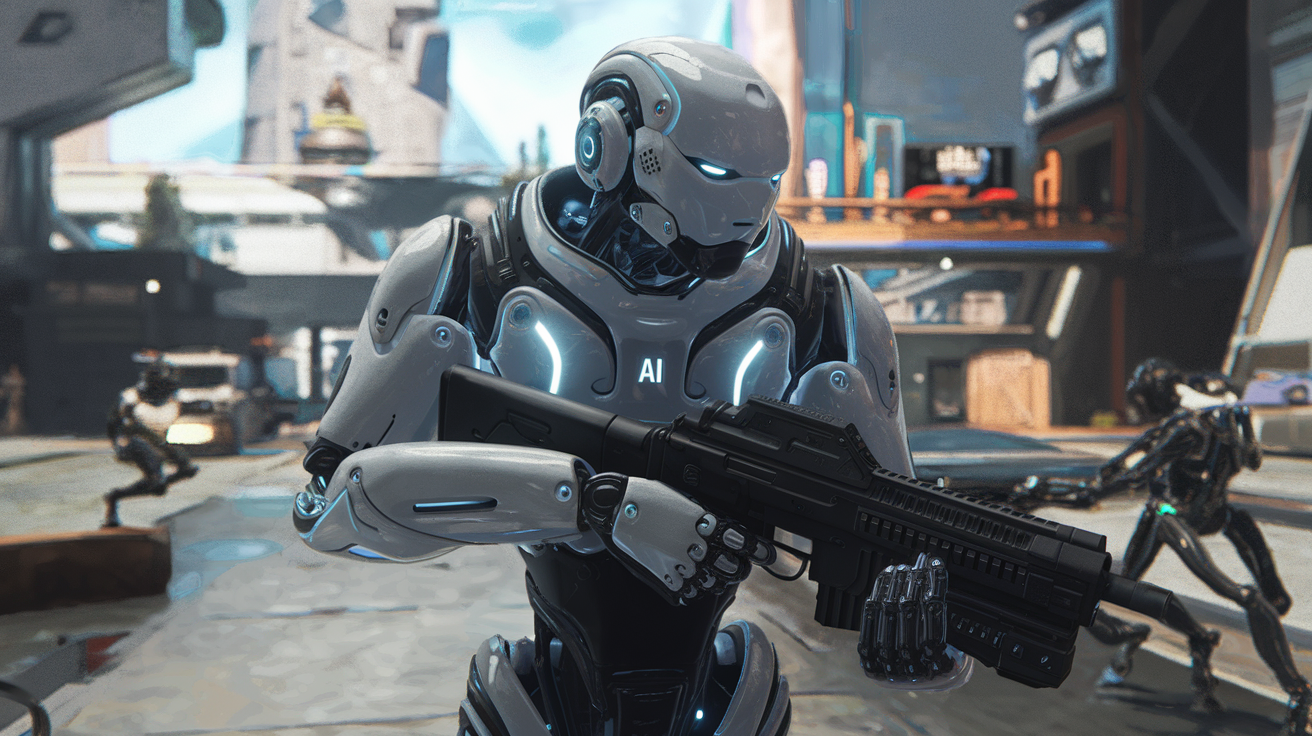
Action models generate optimal physical decisions based on an agent's current observations, whereas world models focus entirely on predicting how an environment's visuals and physics will evolve over time.
While the broader AI industry has poured billions into "world models" that predict next-frame pixels, such as OpenAI's Sora or Decart's physics engines,General Intuition is taking an entirely different approach. In an exclusive interview with GamesBeat, CEO Pim de Witte explained: "We dont build models that predict pixels or compete with game developers. We build models that predict actions."
This distinction is crucial for robotics. A robot vacuum doesn't need to generate a beautiful, photorealistic rendering of your living room; it needs to know exactly when and how to turn its wheels to avoid a dog toy. By focusing on "action-labeled" inputs, General Intuition's dual-model system allows an agent to calculate goal-oriented movements in real time.
The Medal.tv Moat: Harnessing Billions of Human Decisions
General Intuition sources its proprietary training data directly from Medal.tv, a game-clip platform boasting over 17 million active users who generate billions of action-labeled gameplay highlights annually.
The biggest bottleneck in physical AI has always been data. Feeding an AI millions of hours of YouTube videos is relatively easy, but those videos lack context. The AI can see a character jump over a ledge, but it has no idea what button was pressed, how hard the joystick was tilted, or the exact millisecond of latency involved.
Because General Intuition was co-founded by the minds behind Medal.tv, they possess a unique competitive advantage. Every clip shared on Medal can capture exact input metadata. This proprietary "action-labeled gameplay data" acts as a digital transcription of real human intuition.
When a player maneuvers through a complex Counter-Strike map or builds a fortress in Fortnite, they are showcasing spatial awareness, motor planning, and split-second problem-solving. By feeding these telemetry logs into their models, General Intuition is distilling human spatial reflex into a single, highly generalizable codebase.
The Sim-to-Real Leap: From the Lab to the Real World
Yes, behaviors learned in simulated gaming environments can successfully transfer to physical robots with minimal real-world fine-tuning, a process known as simulation-to-real (Sim2Real) transfer.
To prove this, General Intuition conducted an experiment: they trained an AI agent inside a virtual, three-dimensional game space for 100 hours. Without any additional physical training, that model successfully guided a physical, quadrupedal robot across a cluttered room using nothing but a single nose-mounted camera.
This breakthrough has immense global implications, particularly in rapidly growing tech corridors:
- In the United States (Silicon Valley): Companies are eyeing this technology to eliminate the expensive physical testing phases for autonomous vehicles and industrial logistics drones.
- In Europe (Berlin & Amsterdam): Industrial automation firms are exploring Sim2Real transfer to retrain warehouse robots for new SKU layouts without expensive physical reconfiguration cycles, dramatically cutting re-deployment costs.
According to research notes published by The Investor Standard, General Intuition plans to launch its first commercial public API by late summer 2026. This platform will grant global developers access to pre-trained spatial-temporal models, allowing software houses across the US, Europe, and Asia to integrate ready-made spatial intelligence into their own hardware.
The Hard Tech Reality: Compute Costs and "Sim-to-Real" Gaps
While the valuation is dizzying, the path forward is fraught with operational challenges. Building frontier models is incredibly capital-intensive. General Intuition's massive funding round was largely necessitated by the soaring cost of graphics processing units (GPUs). The company's partnership with cloud-compute provider CoreWeave indicates a staggering burn rate, betting heavily that their research trajectory will yield commercial fruits before the capital runs dry.
Furthermore, games operate on logical, clean rules. The real world has dirt, lens flare, friction, and unpredictable weather. While an AI might understand how to navigate a virtual field perfectly, translating that model to a physical robot operating in rain or mud remains an active, high-stakes engineering hurdle.
Frequently Asked Questions
Video games serve as highly accelerated, safe, and cost-effective environments where AI agents can fail millions of times without damaging expensive physical hardware. Games present complex spatial challenges, requiring the AI to learn navigation, planning, and coordination under logical rules that closely mimic physical reality.
The Series A funding round was led by Khosla Ventures, with participation from General Catalyst, Bezos Expeditions (Jeff Bezos), Hillspire (Eric Schmidt's family office), and former Formula One world champion Nico Rosberg, alongside prominent researchers from MIT and Google DeepMind.
Unlike competitors (such as Physical Intelligence or Skild AI) that train models primarily on physical robot telemetry or passive video feeds, General Intuition leverages a proprietary data pipeline from Medal.tv. This allows them to train models on actual human "action data"capturing millions of hours of keyboard, mouse, and controller inputs alongside gameplay video.